Executive Summary
An in vivo PRIMOS CR evaluation of BGT™ TDP-Lip (Tridecapeptide-1) reports a 25% decrease in lower-lip wrinkle appearance at 1 hour, with visible smoothing noted as early as 15 minutes. Built for fast, appearance-focused lip line refinement in leave-on lip products, it supports fuller-looking lips through smoother surface optics—without relying on discomfort cues.
Lip Plumping Peptide Science: Tridecapeptide-1 for Fast Lip Line Smoothing
Most “instant” lip plumpers don’t create confidence—they create sensation. A tingle can be persuasive, but it’s not proof. For a formulator, that’s a problem: you’re being asked to deliver a visible, repeatable result on one of the most reactive areas of the face, and the usual shortcut is irritation dressed up as performance.
The better goal is simpler and harder at the same time: make lips look smoother and fuller without making them feel worse. That means focusing on what the eye actually reads as “plump”—micro-texture, highlight continuity, and the visual softening of fine vertical lines—while keeping claims anchored in cosmetic reality.
This is where a lip plumping peptide approach can be useful, especially when it’s positioned for rapid appearance change rather than a long, uncertain runway.
The Real Problem with Lip Plumpers: Results That Rely on Discomfort
When consumers say they want “bigger lips,” they usually mean “better-looking lips.” They want a cleaner outline, smoother texture, and a surface that reflects light evenly. If the product makes lips feel tight, hot, or irritated, that experience can undermine the very impression the product is trying to create.
From a development standpoint, irritation-based strategies also introduce variability. What stings “a little” for one user can be intolerable for another. That variability turns into inconsistent reviews, higher return risk, and complicated positioning decisions for brands targeting sensitive-skin audiences.
A peptide strategy doesn’t remove the need for smart formulation, but it can shift the emphasis from provoking a response to modulating appearance drivers—especially around expression-related micro-lines.
What Makes Lips Look Fuller: Optics, Micro-Texture, and Motion
Lips look fuller when light behaves predictably across the surface. Fine vertical lip lines break up that light, causing the highlight to fragment. The result is a subtle but important change: the lip reads as drier, flatter, and less uniform—even if hydration is decent.
Motion makes this harder. The perioral area is dynamic. Every word and expression creates micro-folding that can reinforce the look of lines over time. In cosmetics, you can’t claim to “stop movement,” but you can aim to reduce the appearance of micro-creases that are most visible when lips are at rest or lightly animated.
That’s why “instant” matters here. The lip category is used in moments—before meetings, before going out, between errands. A rapid visual improvement fits the real use case better than a promise that depends on daily, consistent use for a month.
Meet BGT™ TDP-Lip: Tridecapeptide-1 Designed for Lip Augmentation
BGT™ TDP-Lip is an active peptide (INCI: Tridecapeptide-1) positioned for lip-focused performance—supporting the appearance of smoother lips and fuller-looking contour. It’s designed for use in lip plumping glosses, anti-wrinkle lip treatments, volumizing lip serums, and rejuvenating lip masks.
Where many peptide stories start with collagen signaling and slow-building structural change, TDP-Lip is framed differently: it’s presented as a neurotransmitter peptide approach intended to influence the appearance of dynamic lip lines by targeting the pathway that drives micro-contraction around the lip area.
For product developers, that difference matters because it changes the promise you can realistically build: not “structural regeneration,” but fast appearance refinement—the kind of immediate improvement that fits modern lip gloss, lip treatment, and hybrid makeup workflows.
How Neurotransmitter Peptides Work: A Clear Mechanism at the Neuromuscular Junction
Let’s keep the mechanism straightforward.
At a neuromuscular junction, a nerve signal leads to the release of acetylcholine (ACh), which binds to receptors and triggers muscle contraction. The TDP-Lip concept is described as competitive inhibition: Tridecapeptide-1 is positioned to compete at acetylcholine receptor sites, reducing signal conduction and supporting a relaxation effect that can soften the appearance of fine lines.
This is the same broad category of logic that has driven interest in other cosmetic “botulinum-like” peptide narratives—while still remaining firmly in topical cosmetic territory. Peer-reviewed literature on biomimetic peptides repeatedly highlights the importance of delivery and realistic interpretation of outcomes: topical peptides may show cosmetic benefits, but their performance depends heavily on formulation strategy and what endpoints are being measured.
The practical takeaway: neurotransmitter peptide concepts aren’t magic. They’re tools. Used correctly, they can support measurable appearance changes—especially in high-visibility zones where micro-lines and movement dominate perceived aging.
Lip Plumping Ingredients Compared: Fast Smoothing vs Long-Term Volume Stories
Not all “plumping” technologies are designed to show up on the same timeline. Some approaches are built to support longer-term improvements in the look of lip density, conditioning, and structural appearance over repeated use. Those can be valid strategies, but they don’t always match the way people actually use lip products—rotating formats constantly, applying on the go, and judging performance in the mirror within the same session.
A fast-smoothing lip plumping peptide story is different. It’s built around the idea that reducing the appearance of lip lines and improving surface uniformity can create a more immediate “fullness” impression. That matters commercially because “instant” is often the deciding factor for repurchase in lip care: if the first application doesn’t do something visible, the formula doesn’t earn its place in the routine.
This is also why how you talk about competition matters. You don’t need to frame other actives as ineffective. You simply need to state the selection logic clearly: when the development brief calls for visible lip line smoothing within a short wear window, a technology positioned for rapid appearance change becomes a more direct match than a technology designed primarily for longer-term, cumulative benefits.
BGT™ TDP-Lip In Vivo Results: PRIMOS CR Shows 25% Lower Lip Wrinkle Reduction (1 Hour)
BGT™ TDP-Lip was evaluated in vivo on human lips using PRIMOS CR imaging, a method that quantifies surface topography to track changes in wrinkle appearance over time. In this test, lower lip wrinkles decreased by 25% when comparing baseline (before application) to one hour after application. That endpoint is directly relevant to what users perceive as “plumper” lips: when vertical lip lines soften, the surface reflects light more evenly and the lip contour reads as smoother and fuller-looking.
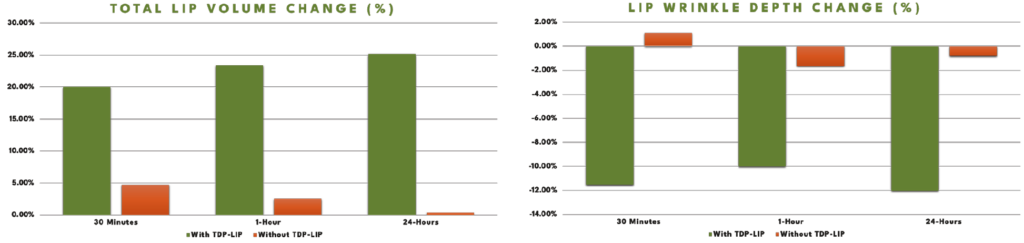
The same in vivo results also indicate visible changes on a shorter clock. After 15 minutes, photos show noticeable smoothing, described as reductions in wrinkles alongside improved-looking fullness, smoothness, and plumpness.
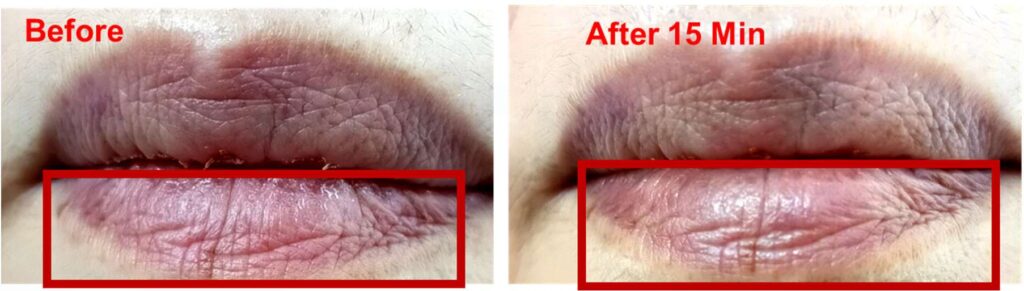
Taken together, this supports a practical performance story for modern lip products: a measurable one-hour outcome paired with a rapid, visible improvement that fits within a real application window—without relying on discomfort cues to signal that something is happening.
15–60 Minutes: What “Rapid Lip Line Reduction” Really Means
Speed claims attract attention, but they also require discipline.
TDP-Lip is positioned to help visibly smooth lip lines within 15–60 minutes after application. From a formulator’s perspective, that statement has two important implications:
First, the endpoint is appearance, not anatomy. You’re not changing lip structure the way an injectable does. You’re changing what the eye sees: line visibility, surface uniformity, and contour clarity.
Second, rapid effect is only valuable if it’s repeatable. If the formula works only under perfect conditions—or if it relies on irritation and discomfort—then speed becomes a gimmick. The commercial goal is a consistent, comfortable experience that performs predictably across users and use occasions.
This is also where language matters. Claims like “augmentation” can be interpreted aggressively in consumer contexts. For many brands, safer phrasing is often more powerful: “visibly plumps”, “smooths the look of lip lines”, “enhances the look of fullness”, and “refines lip contour”. These claims align with how evidence-based peptide reviews recommend interpreting topical outcomes: focus on cosmetic endpoints, avoid implying drug-like physiological change.
Formulating with a Lip Plumping Peptide: Where Tridecapeptide-1 Fits in Lip Products
In vivo performance only becomes a real-world advantage when the formula lets it translate on the lips. Lip products are unforgiving: they’re applied in thin films, they face constant movement, and they’re judged under harsh lighting and close-up mirrors. If the base drags, pills, separates, or feels tight, the user’s attention shifts from “smoother lips” to “why does this feel weird?”
The practical approach is to build the system so it amplifies what the test outcome implies—smoother surface appearance—rather than fighting it. That means prioritizing even laydown, high comfort, and a finish that supports continuous light reflection. High-shine systems naturally help because they create a strong specular highlight; when vertical lip lines look softer, that highlight reads cleaner and the lips look fuller. A dense, cushiony film can also help reduce the look of micro-texture by filling tiny surface irregularities, which is often what the consumer calls “plump.”
Just as important, don’t confuse “instant” with “aggressive.” You don’t need to rely on sting, heat, or irritation cues to signal activity. If the goal is a lip line smoothing story that looks credible at 15 minutes and holds up at one hour, the formula should feel neutral-to-pleasant the entire time. Comfort is not a secondary benefit in lip care—it’s the delivery vehicle for repeat use.
Bring it to Market: What This Means for R&D Teams and Beauty Brands
For R&D, the main implication is that you can design a product around a performance window that matches actual use behavior. Instead of asking consumers to wait weeks to decide whether a lip treatment “works,” you can create a formula that earns belief in minutes and reinforces it over the next hour. That changes how you prototype: you prioritize immediate aesthetics, elegant slip, stable gloss uniformity, and a film that stays comfortable as the lips move.
For brand teams, the shift is equally practical. You don’t need to compete in the “pain equals gain” category of plumpers. You can position around fast smoothing and fuller-looking lips through improved surface appearance, which is easier to align with premium sensorial expectations and sensitive-skin positioning. It also reduces the risk of consumer disappointment caused by harsh sensations that some users interpret as irritation rather than efficacy.
Most importantly, the story becomes easier to communicate in one sentence: smoother-looking lip lines in a short window, supported by a measurable one-hour outcome. That’s clear. It’s testable. And it stays inside cosmetic reality.
BGT™ TDP-Lip™ FAQs
Recommended usage levels are 1–3% (approximately 20–50% of consumers observe lightening of fine lines), 3–5% (fine lines are reduced in 15 minutes), and 6–10% (fine lines are significantly reduced in 15 minutes).
To help preserve performance, many teams add peptide actives in a controlled, lower-temperature step and mix until uniform. Confirm the best addition point by checking clarity, phase integrity, and performance over stability in your final base.
It can be evaluated across multiple lip architectures, but compatibility depends on how the active distributes and stays uniform in the finished system. Prototype in your target format and confirm uniformity, stability, and sensorial before scaling.
Screen it like any lip active: check clarity/haze in high-shine systems, evaluate slip and cushion during wear, and confirm there’s no noticeable taste/odor. Small base adjustments (emollient balance, film formers, or flavor system) usually address early sensory issues.
Build substantiation around the consumer’s mirror-check window: standardized photography at short timepoints plus a repeatable method that captures line visibility or surface topography. Pair instrumental support with a small controlled panel for perceived smoothness and comfort.
Request a Sample: Evaluate BGT™ TDP-Lip in Lip Gloss or Treatments
If you’re developing a lip gloss, lip treatment, or lip mask where fast lip line smoothing is the performance story customers will judge immediately, BGT™ TDP-Lip is built for that moment.
Reach out to Deveraux Specialties to request a sample, technical documentation, or formulation guidance for evaluating BGT™ TDP-Lip in your next lip innovation.
Ready to evaluate BGT™ TDP-Lip™?
Take the next step from insight to action. Review the data, download the PDS, and explore where BGT™ TDP-Lip™ may fit into your next lip innovation.
Forward this article to your Deveraux account managerResources
- Canfield Scientific. (n.d.). Primos CR. https://www.canfieldsci.com/imaging-systems/primos-cr/
- Dermatest. (n.d.). PRIMOS CR. https://dermatest.com/test-methods/primos-cr/
- Happi. (n.d.). Testing Solutions from Canfield. https://www.happi.com/live_from_shows/testing-solutions-from-canfield/
- Lim, S. H., Sun, Y., Madanagopal, T. T., & Rosa, V. (2018). Enhanced skin permeation of anti-wrinkle peptides via molecular modification. Scientific Reports, 8, Article 1596. https://www.nature.com/articles/s41598-017-18454-z
- Pintea, A., Manea, A.-M., & colleagues. (2025). Peptides: Emerging candidates for the prevention and treatment of skin senescence: A review. International Journal of Molecular Sciences. https://pmc.ncbi.nlm.nih.gov/articles/PMC11762834/
- Ngoc, L. T. N., Moon, J.-Y., & Lee, Y.-C. (2023). Insights into bioactive peptides in cosmetics. Cosmetics, 10(4), 111. https://www.mdpi.com/2079-9284/10/4/111
Citation note:
These resources were selected to help formulators and product developers evaluate the lip-plumping-peptide story with confidence. The PRIMOS CR sources provide context for the type of 3D imaging used to quantify surface topography (a practical way to measure changes in lip line appearance), while the open-access peptide papers explain how cosmetic peptides are typically categorized, what limits real-world performance (delivery/penetration), and why appearance-based claims should be framed carefully. Together, they support the blog’s core points: what “rapid lip line smoothing” can realistically mean, how to interpret in vivo imaging outcomes, and how to translate that into substantiation and claims that brands can defend.